Showing posts with label China travel. Show all posts

09 March 2012

Don't stand so close to me (not just in winter)

On the bus, it reeks of down (jackets). (I wasn't wearing one.)

Winter. The season that brings the urge to huddle together for warmth. To that end, the space between you and the next person is already greatly reduced due to the bulkiness of your clothes. It's a real squeeze on the subway seats.

But that's not my grouse. It's with the fact that on public transport, the air doesn't circulate ... much. And the fact that people don't cover their mouths when they cough, sneeze ... talk loudly. If you're unfortunate enough to breathe in your neighbour's germs, highly likely in a usually crowded bus, you will be infected. So that's how I arrived home with my nose running like a tap.

If it's a bun stall, buy a bun!

Buns, or 包, are more popular in southern China than in the north. In the north, another kind of bun with no filling, 馒头, are popular. But don't buy a blueberry pie at a bun stall. At first I bought a 豆沙包, but just out of curiousity, I decided to buy a blueberry pie too. The bun cost Y0.80 and the pie, Y1.50.

Of course the bun tasted better. I only ever bought buns after that.

And a 烧卖 in China is a steamed glutinous rice dumpling, not a Hong Kong-style pork dumpling.

What's this, an umbrella for a drizzle?

When people whip out umbrellas for a little drizzle, it makes me think this is a place not used to rain. But southeast China ought to get a fair amount of rain, I thought. Perhaps not downpours.

But if they're going to tote an umbrella for every little drop, at least practise some etiquette. How do they manage to keep poking my head with it even though I'm so short? No self awareness?

Girls = better hygiene? Surely you jest.

Dormitory living in China in the off-peak seasons have opened the door to a new specimen of fellow travellers - single, yellow, female. Many of them bring tons of stuff in a roller suitcase, and spread this stuff around their beds, under their beds, anywhere they can. These are also the kind of people who buy a piece of papaya, take one bite out of it, and leave it open on the table in the room for days, peel an orange and throw the peel on the floor. Maybe no one has ever impressed upon them the function of a waste basket.

Thankfully, the cleaners mostly clean the room everyday. Maybe. I suspect someone stole at least Y5 in coins out of my coat pocket. And I'm not saying it's the cleaners.

I look forward to returning to Hangzhou in better climes.

Because soggy shoes are absolutely hateful. And I forgot to purchase a new bottle of 花雕酒.

08 April 2011

Over the Hong Kong border

If you went to one of the many Hong Kong-style 茶餐厅 in Shenzhen, you'll find a mug of Hong Kong-style 奶茶 milk tea is priced at between RMB10 and RMB15 (approximately SG$2-3). You may find your bowl of noodles or plate of rice costs about the same. A disconcerting discovery, if you're used to your drink priced at maybe about half the cost of your food. Or teh or kopi from the hawker centre at 90 cents.

In a few months, I may discover how much the Hong Kongers are actually paying for their milk tea. I hope it won't be too shocking.

But other than that, it's a nice jaunt over the border from Hong Kong to Shenzhen, even if only for a day. Lots of Hong Kongers do it - so much so that the Chinese have built a massive shopping centre (a la Lucky Plaza) right beside the 罗湖 Immigration Checkpoint.

For those who need to escape the bustle and crowds of Hong Kong on an extended basis, Shenzhen is convenient too. What works in its favour is a good (and still developing) and fairly new public transport network of buses, subway and relatively congestion-free roads. Relatively smooth roads! Except maybe around the old roads around 东门. But then it's well-serviced by the underground, so really, no need to travel by road.

And you want to go there because even the locals flock there for its cut-throat prices and wholesale markets for everything from shoes and fashion to textiles, toys and electronics. Quality, of course, is not a given - I purchased a pair of amazing super-shrink-in-the-wash trousers for all of $7.

But if you've got money to burn - the culture vultures will suss out the enclaves of the uber chic and arty-farty in double quick time. The highly-rated youth hostel I bunked at is exactly in one of these spots, called 华侨城 or OCT. Uneven cobbled streets, smokers puffing away at cool coffee joints, bars with live music, art galleries, avant garde boutiques, spacey furniture shops peddling mono-coloured home accessories, the Museum of Modern Art and more! Get with the programme - Sotheby's is moving Chinese contemporary art at US$10 million a piece now!

It's too bad I brought too-tight shoes this time around, so walking around all day like I usually do was a real and present pain. Besides that - you know your shoes are too tight when the tips of your toe nails take on a never-seen-before polished glint after several days of walking. Although I can't say if that also had anything to do with what the shoes are made of. Highly unrecommended method of polishing the toe nails.

30 March 2010

Hard road Hainan

My vacations somehow seem particularly arduous. Maybe I need to learn how to take relaxing ones. The ones people imagine when you tell them you're going to Hainan 海南, China's tropical tourist mecca, and they say, 'Sounds relaxing!'

Not being a beach devotee, the first thing I did after a day at the banks in Haikou 海口 was to head for the hills, or rather, the Five Fingered Mountain 五指山.

But the mountain was particularly treacherous, with a trail like a never-ending uneven set of stairs. Some sections even had ladders to scramble up. I can't remember the last time I was on a trail this hard. Gradual, even paths were few and far between. My knees suffered.

By noon, after a 3 hour climb, the clouds descended. Although I was just an hour shy of the summit - I could see it! - I decided to head back. Water was running short and hunger pangs were growing because I had nothing to eat for breakfast. With a whole lot of obstacles in the way, I'm unable to careen my way downhill on gravity like I usually do. My knees, my knees!

Did I mention it's an hour's walk just to get to the nature reserve? On the walk back, an SUV containing two guys offered me a ride. I'm about to expire, but no thanks.

Over the next couple of days, I hobble my way through the crowded beachside hotspot Sanya 三亚 to the laid back kampung-style coconut grove in DongJiao 东郊椰林, which is also by the sea.


I know, it's hard to be impressed after shimmery shiny Tasmania. But interestingly, one needs to cross a body of water on a ferry to get to the coconut plantation, even though it's shown to be connected to the mainland on the map. Missed a photo opportunity of fisher-folk and their catch of the day during the crossing. But hey, check out those ships!

06 March 2010

Daytime Drinking

To the friend with whom I watched Daytime Drinking:

I wonder if you remember the adventures of the protagonist Hyuk-jin, even though we saw it ... well, I'm sure it was at last year's SIFF.

He'd just broken up with his girlfriend and was somehow convinced by his friends to take a trip out to the Korean countryside as a sort of consolation. Only his friends never show up. What follows is a strange sequence of events, where he meets all the characters the countryside apparently has to offer, and in the process has everything taken from him. Except his underpants, it seems.

I remember, in particular, this bit where he gets picked up by a man driving by in a sort of pick-up truck. The man thought he is one of those runners who train up in the hills during the summer, wearing only their shorts. Except it's not summer.

It's a great relief, when you're in a bind in unfamiliar territory, to receive help from a kind stranger. But this can all go very wrong if the stranger turns out to be kind for a reason. The bit where the kind stranger tries to join him in the shower and later, hug him while he's asleep had me squirming in my seat.

It was an anxiety-inducing reminder of the beginning of my trip to Xinjiang (almost 2 years ago now). I'd been waiting by the side of the road for a bus away from Sayram Lake 塞里木湖 in the Tian Shan range. But a storm started to roll in, so I got my umbrella out. It didn't actually provide much protection against the biting wind.

Shortly after, a Kazakh man rolled up on a motorcycle. He offered to give me a ride to some shelter, but I declined. But then he said storms usually last quite long and I would get wet, so (assuming locals know best) I reluctantly agreed. We drove to a little farm shed where he appeared to have misplaced his keys.

Within minutes of our arrival, the storm blew over. So I begun to make my way back to the main road, which wasn't far off. The man, still trying to locate his keys, called after me, 'Wait, I'll get this door open in a minute! You can change your wet clothes in there!'

I wasn't even particularly wet.

Unfortunately for him, I already had my guard up (but apparently still not enough) because the day before had been a terrible day.

I'd arrived by bus, and within minutes, was surrounded by Kazakhs. They want to know if I am staying the night. Then, a Chinese old lady grabbed me by the arm and tried to drag me away, claiming I am a relative. Soon, she is joined by several other Chinese. Bewildered, I resist and an argument starts up between the Kazakhs and the Chinese. The Chinese group is made to leave after it is ascertained that I am not related to them. (Think back to this incident again when the story ends.)

That's when the different Kazakhs start trying to convince me that their place was the best place to stay. Keen to get away from the crowd, I chose a yurt a little further away from the main cluster. It belongs to a large family comprising a set of grandparents, parents and a flock of children, mostly in their teens.

To cut a long story short, one of these teens convinced me to take a horse ride up a nearby hill for something like 5 bucks. Along the way, he squeezed into the saddle behind me. This wasn't pleasant, but I had no idea if it was the norm for 2 people to ride in one saddle.

When we reached the top of the hill, this boy tries to put his arms around me. I manage to escape his clutches, but he grabs my arm. I demanded he let go and he eventually did. Needless to say, I walked back to the camp.

After that incident, spending the night in the family's yurt wasn't a pleasant prospect. This structure is really just a large glorified tent made of animal skins. It simply smells bad. And the covers and bedding smell bad too because they are not only unwashed, they are generally placed in a stack to be used at night by random members of the family - who do not shower. Plus, like any tent, the doors do not lock. I did not sleep well.

When I recounted this story to a friend back in the capital, he said, 'You should've told me, I know some of those people and they are wild.' Not really the best way to find out he hadn't been reading the blog.

To end - y'know how the mantra goes about living without regrets? I reckon, in life, there'll always be times when you wish you could go back and somehow, make better choices. Assuming different choices will lead you to happier endings.

Doubtfully yours, !P

CORRECTION! I previously referred to the people living there as Uighurs. But I had a nagging feeling it wasn't accurate so I did some research and it turns out the ethnic minority living in that particular region are the Kazakhs, a Turkic people from the northern parts of Central Asia who were initially of pure Caucasian origin.

27 April 2009

Nudity

It appears to be a potentially scintillating, titillating topic of conversation.

Especially with a member of the opposite sex (or whoever rocks your boat) and a relatively dishy one, at that.

But even more so if it's not carried out face-to-face, where even if you become a red-faced stuttering fool, no one knows.

I found myself in such an on-screen conversation one day, with a person of interest from a part-time job back in China.

We were simply extolling the joys of not having flat-mates, until it was revealed that he liked to walk around his apartment in the buff.

Then came the question, 'Don't you?'

Did I take two years of sewing classes because I enjoy lounging around unclothed? I think not.

I didn't phrase my answer quite in that conversation-killing way, but it was still somehow doomed. I tried, I really did. I talked about a friend who also liked lounge with not a stitch of clothing on around the flat she shared with her partner. I talked about nude colonies. I talked about how nudity must be difficult in winter, peeping neighbours, all to no avail -- it's not even funny how bland the conversation was.

Disappointingly, pretty much all conversations with this person of interest turned out to be bland, inadvertently proving that looks aren't everything after all.

But in all fairness, nudity isn't all it's cracked up to be. Having lived and travelled in East Asia, I've seen, and been seen by more naked people than I can remember or count. And they come in all ages, shapes and sizes.

It's mundane. You take off your clothes, take a shower, put them back on. You take off your clothes, get into the sauna, get a massage, put them back on. You take off your clothes, shower, jump into the hot pool, jump into the cold pool, rinse, put them back on.

The naked people chat as they shower. Naked children swim and splash in the hot spring water. In the sauna, there's nothing much to see beyond the condensation in the air; and vision is limited during a massage.

Except at a certain spa chain in the Xinjiang capital of Urumqi.

I'd been recommended the well-known local spa centre by a middle-aged cleaning lady at the youth hostel. It turned out to be one of those bath house kind of places people go to to lounge around in identical t-shirt-and-shorts ensembles. Like those you see in Korean dramas sometimes.

That was the general impression, until I found myself in a robe inside a red room. It contained a double bed, covered with red silk sheets and pillows, facing a mirror wall. There was also a large television and other furniture. Only one word to call this -- parlour.

Then the masseuse arrived clad in a brocade cheongsam micro-mini dress.

I began to suspect the massages are a service used predominantly by men. It was, in any case, the oddest massage I've ever encountered.

Besides the usual kneading, she folded and stretched my limbs into yoga-like poses. And thanks to the floor-to-ceiling mirror, I am able to report that some of these look like really bizarre sex acts.

So I can now safely say that I'll be sticking to the conventional spas involving soothing new age music, aromatic oils and a massage bed that limits the vision, thankyouverymuch.

16 March 2009

广东:迎接与告别

欢迎来到我们的小岛!

你不懂吗?机场大厅涌上来的那股冷风是带着这么一个热烈迎接。里头还藏了个小提示:我国的冷气是世界第一哦!

你说什么?这忽冷忽热的感觉让你头昏脑胀,甚至病倒?那怎么可能,我们的市民过得很好呀!要是不把巴士里的气温往下调,那我们为巴士司机定做的夹克不是浪费了吗?反正现在全球气温逐渐上升,即使没有我们的超强冷气,忽冷忽热的现象也会变得越来越普遍,就像广州的春天一样。那个日本小子竟然因为刚到广州的那阵子“太热”而感冒了。真不像话。

他说他要跟着我去旅行,不过坚持不到两天就放弃了。(怎么突然觉得跟我一起旅行是一件让人难过的事啊?)他说他不爱旅游中国,因为看到的东西都是一样的。他说他喜欢感受当地的平日生活,结果下午我们到网吧、晚上去玩电动。出来的时候,又下雨了。

发现他会抽烟的那刹那,我的心似乎停了一拍、脑袋一片空。那是失望的感觉吗?还是意识到对这个人的了解原来不那么深的那种沉重?

告别的时候,我先上车了,也没回头微笑挥手。

我斗不过阴冷的天气,只能埋怨。有个中国小弟劝到:还是把该玩的都玩完吧,不然就后悔了。

我果然后悔了。后悔没多购物,没把行李都添满,没多吃,没把钱花光。虽然满载而归的计划失败了,但还有下次。你们等着吧。你们看着吧。我是说照片啦。

08 March 2009

Wind whirl Guangdong 广东

Guangzhou the city is plagued by a fine drizzle and mist for the duration of my stay. Just before I was due in the city, the mecury plummets from the 20s to the region's winter-like lows of under 15. I'd packed the grand total of one cardigan.

The drizzle seems to escalate into a brief shower every few days, but for the most part, it's so fine no one'd bother taking out their umbrella if it were to happen back home. But here, people whip out their umbrellas readily. The Guangzhou metro even has largish umbrellas for loan.

I forged ahead with my plan to see the various sights the Cantonese-speaking province had to offer. On my first stop, Zhaoqing 肇庆, I had an under-the-weather Itsuo in tow. We made it to the city's old walls and a mountain park 鼎湖山 just outside the city, within which there were a loverly waterfall, various lakes and a centuries-old temple built on the hillside.

Unfortunately sight-seeing doesn't amuse my companion, who readily took up my suggestion that he move on to his next destination further north the following day. Venturing out later that night, we chanced upon an excellent late night meal of grilled oysters and claypot oyster porridge for a mere S$11.

Thusly, I headed for Qingyuan 清远 the following day amid a moderate fog. This escalated into a moderate shower halfway to the city. That stopped sometime in the afternoon, even letting some sunshine sneak through before more grumpy clouds rolled in. Thus encouraged, I larked around for another day in hopes of visiting a nearby mountain, only to have them dashed.

Then, I had a brilliant idea. Or so I thought.

Since there's no sight-seeing or hiking to be had, I'll just spend my time riding buses from one city to another. What better way of seeing the province than by sitting in the comfort (and relative warmth) of a bus?

There was no bus to my next desired destination of Chaozhou 潮州, so I got on a bus to Shaoguan 韶关 in the north of the province instead. This city had previously already been struck off, as I'd planned it as a white-water rafting destination. Such an activity just wasn't that enticing in coat-wearing conditions. Not wanting to spend another night in another dodgy guest house 招待所, I thought I'd be able catch an overnight bus to Chaozhou from here. Shaoguan turns out to be a rather pleasant city with a wide river coursing through its centre, on which people were doing what looked like kayaking.

As big and pleasant city as it was, its bus offerings to the east of the province was paltry at best. Only one bus to Chaozhou a day, leaving at midday and arriving at about 10am the following day. I'd just missed it, of course. And that it'll take almost 24 hours is mind-boggling, since it should technically be an under 10-hour journey. Thus defeated, I hopped on a bus back to Guangzhou in hopes that there'd be an overnight bus there.

But of course there wasn't.

This is how I am resigned to spending the rest of my time in Guangzhou. On the bright side, there're things to do despite the miserable weather. I now have some new shoes (in addition to those I'd already pre-ordered online) and my stomach's swimming with a dozen oysters (steamed, this time) I purchased for a mere S$6.

It's more of a civilised city than those I'm used to in the north, smoke-wise. The bus driver on the way to Guangzhou told off a passenger for smoking inside the bus. "Who's been smoking in the bus, it's so smelly! Is this the first time you're venturing out on a bus? What if I get dizzy driving from the smoke?" Most won't smoke inside a restaurant too. Also, they've got dessert stalls everywhere selling such delights as steamed milk custard 双皮奶 and sesame paste 芝麻糊.

Hmm, it's getting chilly again. Time for more food.

01 December 2008

Pictures

Geepers, I've been lazy with the blogging lately.

I'd planned to regale you with some Xinjiang travel tales, y'know?

But ... soon, I will. 

Meanwhile, go see the pictures!

Xinjiang, China

Osaka & Kyoto, Japan | Nara, Kobe & Himeji, Japan | Shikoku, Japan | Yokohama & Tokyo, Japan

13 June 2008

In the Chengde Hills

Last weekend saw the Dragon Boat Festival 端午节, one of two 'new' three-day weekend public holidays introduced by the Chinese government.

While I didn't actually consume any that particular Saturday, when I made my way to the post office, dragging more than 20 kilograms of belongings, I was pleasantly assaulted by strong whiffs of freshly steamed glutinous rice dumplings. Tempting, but I rather prefer my dumplings packed with savoury or sweet fatty pork and chestnuts than red beans, green beans, or a meagre sliver or two of lean meat, which appears to be what the Chinese offer. Alternatively, I will accept them all rice and no filling with a generous dollop of sugar, thank you very much.

One of the Americans in Chengde 承德 received some unexpected dumplings. A Chinese lady who lived in his building walked into his apartment, dumped a bag of them on his kitchen table and left without saying a word. No small talk, awkward questions, smiling stupidly, and still there's free food. A perfect neighbour for me, methinks.

The American told this story at a local restaurant where we had dinner. The restaurant's speciality (and name) is 干烧鱼, which appears to be a sort of fish dish that's been deep-fried too long. Tasted like it too. The Chinese constantly revolved the lazy Susan such that the fish almost always stopped in front of me. She was of the opinion that I should eat it since I ordered it. Admittedly, I was seduced by the notion of fish, but the dish came highly recommended by the Americans, who even made certain it had been ordered. But of course their palates are too delicate to be made to endure that crisp disaster of a fish.

Strangely, although we were a party of five, the Chinese thought three dishes were sufficient. Having spent lunchtime that Sunday in a 4-hour Chengde-bound bus inhaling cigarette smoke and the entire afternoon hiking in the Chengde hills in search of oddly-shaped rocks, I suddenly missed my ex-colleagues. My first colleagues in China, the ones who would go as far as to order to a 1:1 ratio at lunch. I ate well back then.

One of the party was vegan, so the Chinese picked a dish of green peppers, because she liked spicy food, in spite of the waitress explaining that that particular dish took a while to prepare. The other order was 鱼香肉丝, a dish of pork slivers and shredded carrots in a salty, spicy sauce. Apparently her favourite dish, and thus a must-have.

As the food quickly ran out, three of us were forced to ask for a bowl of rice each. To salvage the situation, an additional order of vegetables was also made. It thankfully turned out to be a plate of stir-fried zucchini.

Dinner was split 5 ways, and the group adjourned to a residential compound and kicked a Chinese shuttlecock around until two American-accented Filipino girls, friends of the Chengde Americans, showed up. The group then made its way to the other American's flat, where the three of us from Beijing were afforded the night's lodging free of charge.

There, I proceeded to take a shower and then got into bed, while the rest put a movie on loud, drank beer and the Americans chain-smoked. Smelt like it, anyway. A couple of hours later, the two Filipinos left and the Finnish went to bed, leaving the two Americans and one Chinese to partake in more alcohol, movies and cigarettes. I know this because Chinese flats have thin walls/doors and I am a decidedly light sleeper.

A couple more hours later, one of the Americans knocked over a bottle of something in an attempt to find a glass of salt water to make himself feel better. I imagine he then fell asleep on the couch. Afterward, the sounds of vomitting and weeping began. The Chinese was weeping because she was having trouble "releasing" herself, and vomitting because she had had too much to drink (this second point is pure speculation on my part). The American was consoling her with "no one can help you if you don't let them", which would sound fairly reasonable if it wasn't followed by hee-hee-hees.

It was light when the television was finally switched off and silence reigned. Didn't last long. Light meant people would get up and about, so doors started banging and I was treated to snatches of conversation as people walked past the ground floor flat. Guess it was a good time as any to make my way to breakfast and the massive Mountain Resort (of Emperors KangXi and QianLong) 避暑山庄.

The Finn and I met up at the Mountain Resort and we spent the entire day walking around lakes, up and down a mountain, through a valley, past tame spotted deer and was overtaken countless times by mini-trams of Chinese tourists.

I was also enlightened: Last night was apparently a typical young-single-American weekend. Learning that and seeing Chengde in two days, not half bad eh? While you'll've to nab yourselves some young single Americans to experience the sleeplessness, here's a glimpse of some loverly bits of Chengde, the city in the green mountains of the Hebei province.

Random sections of the Great Wall can be seen during the 4-hour bus ride to Chengde.

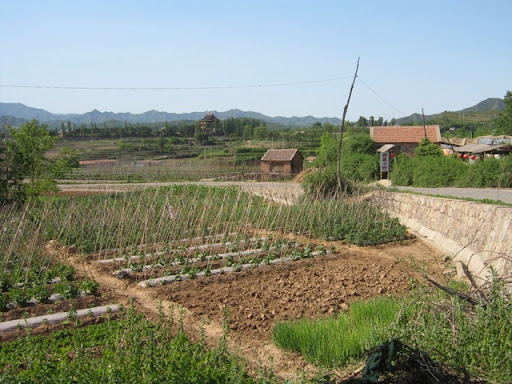
Lots of agriculture going on in the Hebei province, being a little further away from the desert sands than Beijing.

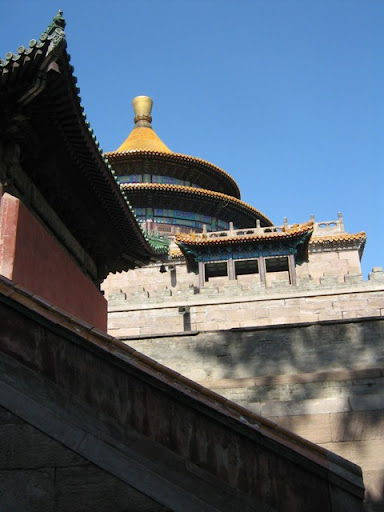
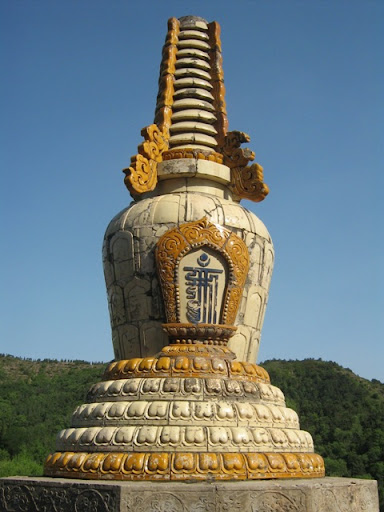
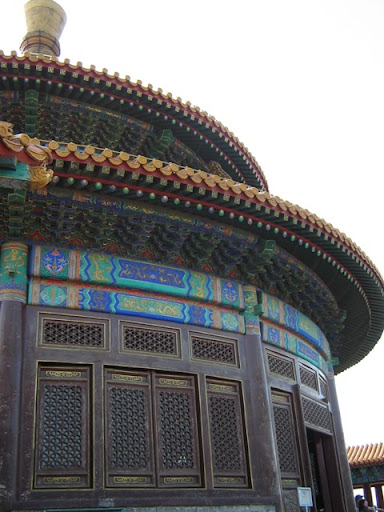
Pule Temple 普乐寺, built in 1766 during Emperor Qianlong's reign, is a UNESCO World Cultural Heritage site.

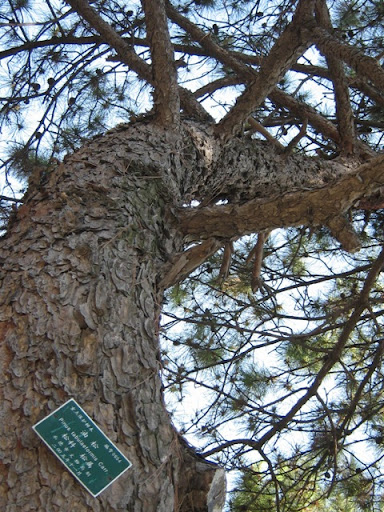
油松: One many old pine trees found within the temple's compound.

Built in a mixture of Han and Tibetian style similar to Beijing's Temple of Heaven 天坛, Emperor Qianlong named it Pule Temple, "implying universal happiness, unity and peace".

The main dome is a smaller copy of Beijing's Temple of Heaven.

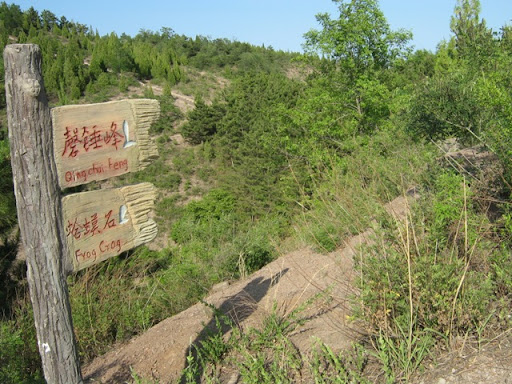
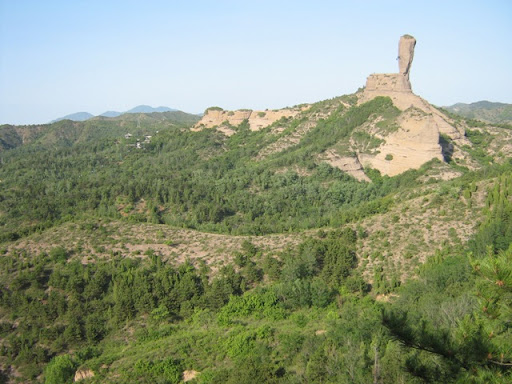
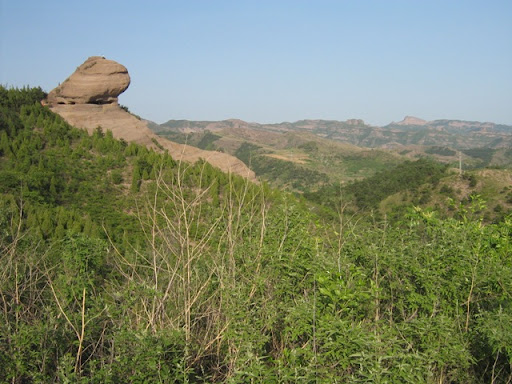
To the east of the temple are the Sledge Hammer Peak 磬锤峰 and Toad Rock 蛤蟆石.

Which are a long, long way away.

But we got there eventually, of course.

Chinese visitors come armed with sticks of red incense, which they wedge on the Toad Rock for health. Or luck, or some such.

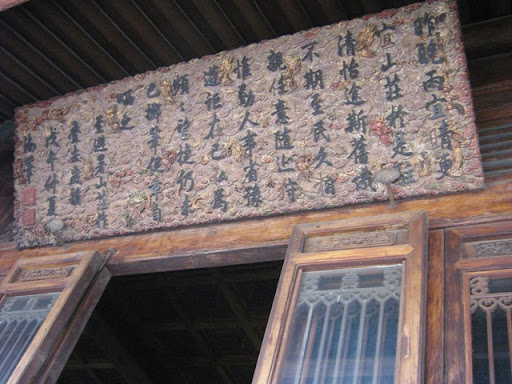
Above the various doorways of the main hall of the Mountain Resort 避暑山庄 hang four poems penned by one of the emperors, each written during his visits to the resort.

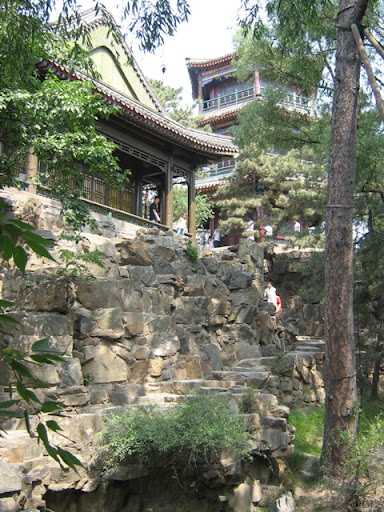
One of many pavilions dotting the massive Mountain Resort, which is the largest imperial palace garden in China and a UNESCO world cultural heritage site.

One of many temples in the resort. The 5.64-million-square-metre resort has a palace area, lake area, plain area and mountain area to reflect the characteristics of north and south China.

Unfortunately, Chengde is located in the northern region, which suffers from water shortage, so many of the little rivers and streams that used to be presided over by "gates" such as this have all but dried up.

30 May 2008

The Great Escapade I

I have a cunning plan.

Having tendered my resignation, time is now well spent plotting my escape via Xinjiang (or s'posedly the "New Frontier") in northwestern China over approximately 15 days (or what time's left on my Chinese visa). Much of this time will be spent on buses, since the rail tracks neither cross the Taklamakan Desert nor go over the Tian Shan range.

. . .

To heighten your appreciation, a little background on Xinjiang, courtesy of Wikipedia, our favourite non-official source of information! (Alas! I would also have included a map, but couldn't locate a suitable one.)

Xinjiang 新疆 is an autonomous region (Xinjiang Uyghur Autonomous Region) of the People's Republic of China. It was militarily captured and annexed by China and is a large, sparsely populated area (spanning over 1.6 million sq. km) which takes up about one sixth of the country's territory. Xinjiang borders the Tibet Autonomous Region to the south and Qinghai and Gansu provinces to the southeast, Mongolia to the east, Russia to the north, and Kazakhstan, Kyrgyzstan, Tajikistan, Afghanistan, and the Pakistan- and India-controlled parts of Kashmir to the west.

It is divided into two basins by Mount Tianshan. Dzungarian Basin is in the north, and Tarim Basin is in the south. Xinjiang's lowest point is the Turfan Depression, 155 metres below sea level (lowest point in the PRC as well). Its highest peak, K2, is 8611 metres above sea level, on the border with Kashmir.The Tian Shan mountain range marks the Xinjiang-Kyrgyzstan border at the Torugart Pass (3752 m). The Karakorum highway (KKH) links Islamabad, Pakistan with Kashgar over the Khunjerab Pass.

. . .

It should begin innocuously enough with a 4-hour flight into Xinjiang's captial, Ürümqi 乌鲁木齐. The largest city in the western half of China, Ürümqi has won a place in the Guinness Book of Records as the most remote city from any sea in the world. Four hours later, we'll be on a west-ward flight bound for Yining near the Kazakhstan border. A "leafy and friendly" city, says Lonely Planet.

Granted, all that flying detracts from my usual mode-of-travel, but time is short and the fastest train to Ürümqi will plod along for all of 40 hours and 6 minutes, not to mention only save me a paltry Y104 on a soft sleeper. Most importantly, energy needs to be conserved.

While in Yining 伊宁, my backpack and I are going 120 kilometres north into the Tian Shan range to see the Sayram Lake 塞里木湖, "especially colourful during June and July, when alpine flowers blanket the ground". If the alpine flowers bit fails, we will at least get to spend the night in a Kazakh yurt near the lake. Maybe.

The actual reason we're going to Yining is to sit in a bus, bound for Kuqa 库车, for 24 hours. This course of action is based solely on LP's "spectacular trip crossing the Tian Shan range" description. If the spectacular bit fails, we will at least get to see, mid-way, a Mongolian village-closed-to-foreigners called Bayanbulak.

Although once an oasis on the Silk Road, apparently not much to see in Kuqa, so we will promptly get on with a 9-hour train journey heading west for Kashgar 喀什, sited west of the Taklamakan Desert at the feet of the Tian Shan mountain range. Kashgar is home to an important Muslim community (Uyghurs). The area does not have the same high level of Han Chinese immigration as does Ürümqi.

Lots to do in Kashgar! A lively Sunday Market and Livestock Market, mosques, tombs, ruins and Uighur food at the night market ("bring your own fork")!

And, "if you'd like to see the Karakoram Hwy 中巴公路, Karakul Lake, a glittering mirror of glacial peaks, makes for a good destination". That's where we're headed, then. The Karakorum Hwy, gateway to Pakistan, is a centuries-old route used by caravans going down the Silk Road, passing through "high mountain pastures with grazing camels and yaks". If the camels and yaks fail to make an appearance, we will at least get to spend the night in a Kazakh yurt near the lake. Second attempt to, anyway.

(The Kite Runner movie was filmed in Kashgar! Haven't seen it, but it's an excellent novel, read it and ... at least sniffle?)

A few days in Kashgar and it's off to Hotan 和田, another 9-hour journey possibly split into two parts by way of the old town of Karghilik on the Silk Road. Hotan is included in this escapade, again, because of a bus ride. This ride, lasting 15 hours, plods 500 kilometres on a highway through a "rippling ocean of sand" that is the Taklamakan Desert to reach a small town called Luntai 轮台 on the other side. "The slightest bit of bad weather can stop traffic for days". Hmm, getting delayed for days can't be good. This bit may need further research.

Onward! From Luntai, it's an hour and a half on another bus back to Kuqa, followed by 13 hours on the east-bound train to Turpan 吐鲁番, the second lowest depression in the world (after the Dead Sea) and the hottest spot in China, just 2.5 hours by bus from Ürümqi (from where we fly to Beijing and onward to the loverly Japan, but that's not yet ripe for elaboration). Ye gods! I trust it won't hit the highest temperature mark of 49.6 degress C while I'm there. Although, this bit of the journey may not happen due to time contraints.

And so, it all adds up to 15 days (hopefully), 9.5 hours in the air, 22 hours in trains and 52 hours in buses. Sounds gruelling, even for a pared-down version of an even more ambitious plan involving the neighbouring Gansu Province that pushed 21 days. Curses to the HR department for robbing me of leave days!

Again, touch-and-go isn't how I usually travel, but with no foreseeable plans to revisit the region, we do the best we can against time. Will we make it? Stay tuned ...

NB. If you've got some very important information I've somehow missed (the sort that will get me a free pass to a Chinese jail/ginormous fine for reasons such as over-staying my visa or patronising un-PSB-authorised yurts), drop me a note!